
When the customer is faced with the problem of sealing between components that move against each other at will; the easiest, safest and most effective solution is to use a inflatable seal o pneumatic joint.
Index
Characteristics of inflatable seals
The inflatable seals expand when compressed air is injected into the valve and return to their shape when the valve of the inflatable seal releases the compressed air. Operation is simple.
The inflatable seals meet temperature ranges from -65 ºC to +315 ºC, depending on the elastomer formulation. The materials most in demand are VMQ silicone gaskets, CR chloroprene gaskets, EPDM gaskets, FMVQ fluorosilicone gaskets, FKM fluorinated rubber gaskets, NBR nitrile gaskets and SBR styrene-butadiene gaskets., among others.
The inflatable seals withstand pressures from dynamic vacuum up to several tens of bar. Depending on the working pressure, we offer profiles for high pressure and low pressure. And a series of special profiles in sealing, coupling, handling and fastening services.
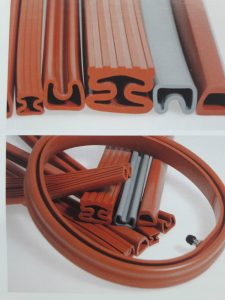
The inflatable seals are used in all sectors of industry, including advanced technologies and scientific research. Thus, for example, they can be installed pneumatic seals in:
- - Mobile cofferdam gates.
- - Containers and vats.
- - Hermetic panels for the marine and aerospace industry.
- - Nuclear vessels (equipment or personnel chambers).
- - Isothermal chambers.
- - Sterile clean rooms.
- - Sliding or fast closing doors (autoclaves and sterilizers).
- - Centrifugal filters (access doors and discharge hoppers).
- - Aircraft access doors.
- - Cabin dome.
- - Locks and gates.
- - Pneumatic conveyors (bagging hoppers, valve doors).
- - Acoustic insulation.
- - Collar to immobilize shafts.
- - Surface survey.
Inflatable seals available from Epidor SRT
At our catalog we offer linear, circular and rectangular inflatable seals with rounded corners or 90º angled corners. In the case of inflatable seals In the case of circular formats, expansion can be radial expansion on the inside or on the outside. In the case of rectangular formats, we speak of axial expansion on the inner or outer face. The linear segment can only expand axially.
Depending on the requirements of the application, the inflatable seals, inflatables o pneumatics are manufactured with FDA materials and then refer to FDA gaskets.
Experience has shown us that it is not feasible to extrude and store meters and meters of profiles to vulcanize, add the valve and obtain the inflatable seal, with a delivery time of almost just in time. In these cases, the inflatable seals fail prematurely due to material fatigue problems.
On the other hand, the critical area of these seals is located at the valve insert. If no receiving cone is provided, the valve base slowly tears the contact point as the expansion and contraction cycles occur.
The inflatable seals that we distribute are manufactured to order and with a cutting-edge technology, The design of the valve cone and the “hot” vulcanization, i.e. up to a maximum of 48 hours after the extrusion of the working profile.
If you are having problems and you found this article interesting, we encourage you to consult us about your problem and allow us to advise you on a solution. You can contact us at contact with us here.
